Key Takeaways
SEO topic clusters organize related content around one central topic.
Strong internal linking improves crawling and user experience.
Topic clusters help establish topical authority.
Supporting content captures more search intent.
AI search engines reward comprehensive content coverage.
Every supporting page should provide unique value.
Topic clusters require planning, not just publishing more articles.
Build Topical Authority With a Smarter SEO Strategy
Search engines have evolved far beyond matching individual keywords. Today, Google looks at how well your website covers a subject. One of the most effective ways to demonstrate expertise is by building SEO topic clusters.
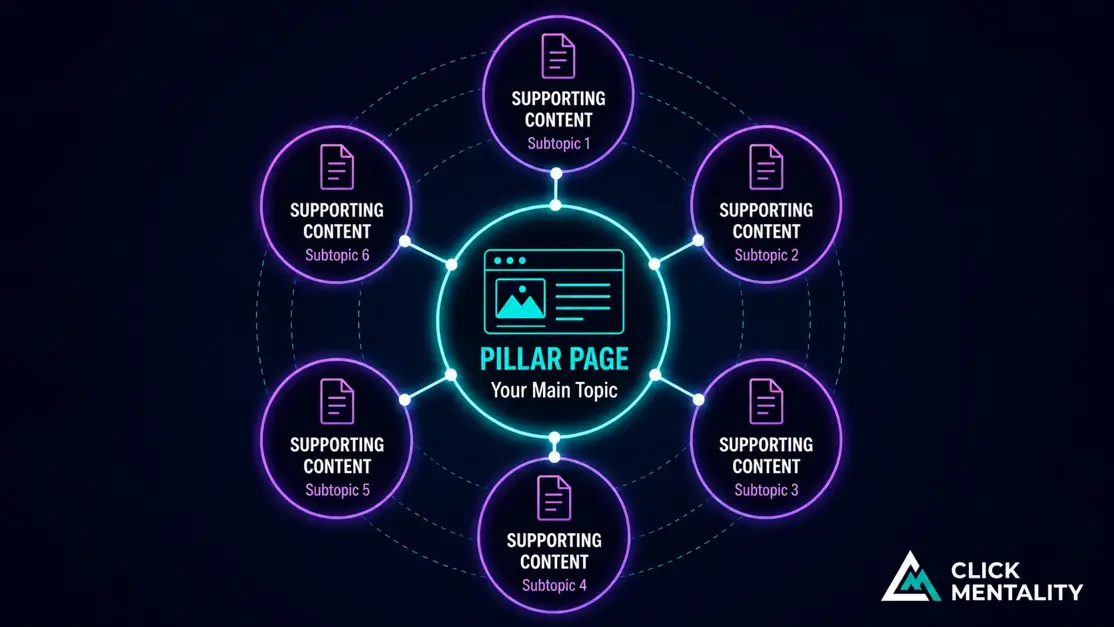
A topic cluster organizes related content around one comprehensive pillar page. Each supporting article focuses on a specific subtopic and links back to the main page, helping search engines understand your expertise while making it easier for visitors to find the information they need.
Whether you are creating new content or improving an existing website, a well-planned content cluster SEO strategy can strengthen rankings, improve user experience, and increase organic traffic over time.
What Are SEO Topic Clusters?
SEO topic clusters are groups of related content centered around one primary topic.
Instead of publishing isolated blog posts that compete against one another, you organize content into a structured hierarchy.
For example:
Pillar Page: Complete Guide to Local SEO
Supporting content:
How Google Business Profile Works
Local Citation Management
Local SEO Ranking Factors
Local SEO Audit Checklist
Local SEO for Multi-Location Businesses
Each supporting page links back to the pillar page, while the pillar page links to each supporting article.
This structure helps search engines understand the relationship between your content.
Why SEO Topic Clusters Matter
A strong SEO cluster content strategy provides several benefits.
Build Topical Authority
Publishing multiple high-quality articles around one subject demonstrates expertise. Search engines are more likely to trust websites that thoroughly cover a topic instead of publishing one standalone article.
Improve Internal Linking
Every supporting article strengthens your internal linking structure.
Better internal links help search engines crawl your website while guiding visitors to additional valuable content.
Google recommends using a clear site structure and internal links to help search engines discover and understand your content.
Capture More Search Intent
People search in different ways.
Example:
One visitor may search for "SEO topic clusters."
Another may search for "content cluster SEO."
Another may ask ChatGPT how topic clusters improve rankings.
A cluster strategy allows your website to answer all of those questions.
Improve AI Search Visibility
AI-powered search tools evaluate topic depth differently from traditional search engines.
Publishing comprehensive topic clusters helps AI understand your expertise and increases the likelihood that your content will be referenced in AI-generated answers.
What Topic Clusters Are Not
One misconception is that topic clusters simply mean writing several blog posts about the same subject.
They are not.
SEO topic clusters are not:
Random blog posts that happen to share a keyword
Duplicate articles targeting slight keyword variations
Pages without internal links
Content published without an overall strategy
Keyword stuffing or repeating the same information
Successful SEO topic clusters are carefully planned. Every page should have a unique purpose while supporting the broader topic through strategic internal linking.
This approach helps search engines understand your expertise and can also improve your visibility in AI-powered search. Learn more in our guide on how to rank in ChatGPT Search.
How to Build an SEO Topic Cluster
Step 1. Choose a Core Topic
Start with one subject your audience actively searches for.
Examples include:
Local SEO
Technical SEO
Google Ads
AI Search Optimization
Step 2. Create a Pillar Page
Develop a comprehensive guide that introduces the topic and links to supporting resources.
Step 3. Identify Supporting Topics
Research questions, long tail keywords, and related searches.
Each supporting page should answer one specific question in depth.
Step 4. Connect Everything
Link every supporting article back to the pillar page.
The pillar page should also link to every supporting article.
This creates a clear content hierarchy.
Step 5. Continue Expanding
Topic clusters are never truly finished.
As search trends evolve, continue adding new supporting content to strengthen your authority.
Common Topic Cluster Mistakes
Many businesses struggle because they:
Publish unrelated blog posts
Target the same keyword repeatedly
Forget internal linking
Never update older content
Create shallow articles with little value
A well-organized content cluster avoids these problems.
Real World Example
Imagine your website offers SEO services.
Instead of one SEO page, you create supporting resources covering:
Local SEO
Technical SEO
On Page SEO
SEO Audits
ChatGPT SEO
AI Search Optimization
Content Optimization
Together, these pages build authority around SEO while giving visitors multiple entry points into your website.
Ready to Build a Smarter SEO Content Strategy?
Publishing more content is not enough. Your website needs a strategy that builds authority, improves rankings, and keeps pace with evolving search.
At Click Mentality, we create SEO topic clusters that help businesses strengthen topical authority, improve internal linking, and attract qualified traffic. Whether you are starting from scratch or expanding an existing content strategy, our team can help you build content that performs.